Why this matters
The hydrostatic test is the contractual proof that a pressure-piping component holds without leaking at the design condition. ASME B31.3 — Process Piping is the most widely cited code for chemical, refining, and energy projects. Its requirements for hydrostatic testing are explicit on minimum pressure, hold time, gauge accuracy, and water quality. Buyers who witness a hydro without knowing the code allow short-cuts that would never pass a TPI audit. This guide walks through the hydrostatic test procedure for pipe fittings under ASME B31.3.
A disciplined hydrostatic test procedure for pipe fittings under ASME B31.3 catches every leak path before the line goes into service.
Step-by-step procedure
1. Calculate test pressure. Per ASME B31.3 para 345.4.2, hydrostatic test pressure is at least 1.5 × design pressure, with correction for temperature: P_T = 1.5 × P × (S_T / S), where S_T is the stress at test temperature and S is stress at design temperature, capped at the yield stress. For a typical 600# carbon steel system at 1480 psi design, the hydrotest is 2220 psi at room temperature.
2. Reduce only when necessary. ASME B31.3 allows the hydrostatic test pressure to be reduced to as low as 77% of the calculated value if a higher pressure would exceed the test pressure of an installed vessel that must be in the loop.
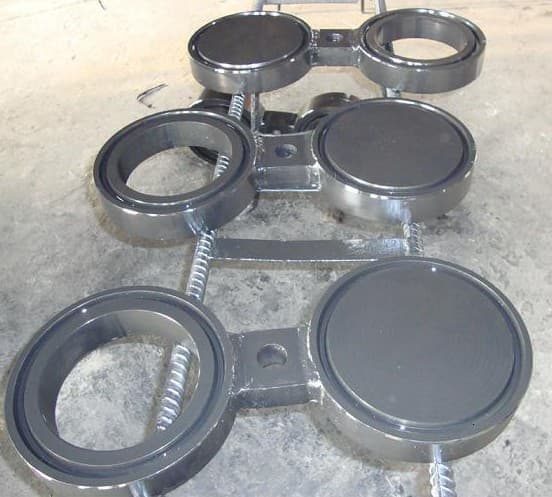
3. Prepare the test loop. Vent high points, drain low points, isolate equipment that cannot accept test pressure, blind-flange the boundaries. Calibrated pressure gauge with range 1.5–4× test pressure, calibration within the past 6 months.