Why Method Selection Matters
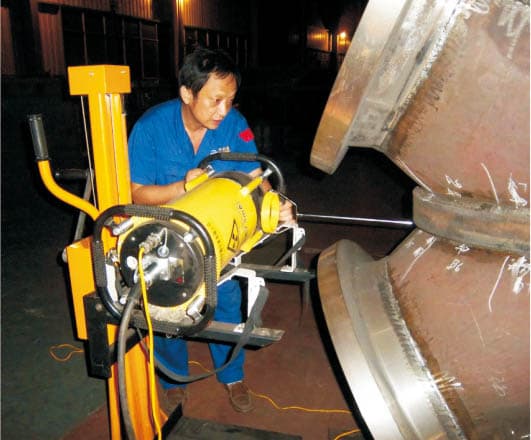
Every non-destructive test method only sees the defects it is designed to find:
- PT (dye penetrant) — surface-breaking discontinuities only
- MT (magnetic particle) — surface and very near-surface (≤ 3 mm), ferromagnetic only
- UT (ultrasonic) — internal volumetric defects
- RT (radiography) — internal volumetric defects with film/digital record
Specifying the wrong method for the defect type your service is sensitive to means the inspection certificate looks clean while the killing flaw is still in the part.
Method-by-Method
PT (Liquid Penetrant Testing)
What it sees: Surface-breaking cracks, laps, porosity opening to the surface
Materials: Any non-porous material (carbon steel, stainless steel, duplex, copper alloys, etc.)
Best for: Stainless / non-magnetic alloys, weld bevels, fitting end-faces, machined surfaces
Limitations: Cannot detect subsurface flaws; surface must be cleaned to bare metal; cannot use on porous materials
Typical use on fittings: PT on bevel ends of stainless A403 WP304L / WP316L fittings, where MT is unsuitable because of the non-magnetic structure.
MT (Magnetic Particle Testing)
What it sees: Surface and shallow subsurface discontinuities (down to ~3 mm)
Materials: Ferromagnetic only — carbon steel, low-alloy steel, ferritic stainless (400 series)
Best for: Forged carbon-steel flanges, A234 WPB elbow bevels, weld toes
Limitations: Will not work on austenitic stainless (304/316) or non-ferrous; multi-direction magnetisation often required
Typical use on fittings: MT on bevels of A234 WPB / A105 / WPC fittings as a faster, cheaper alternative to PT for ferromagnetic material.
UT (Ultrasonic Testing)
What it sees: Internal volumetric defects (laminations, inclusions, internal cracks); wall-thickness measurement
Materials: Most metals; austenitic stainless requires special probes
Best for: Wall-thickness verification on heavy-section forgings, lamination check on plate-derived fittings, weld interrogation as an alternative to RT
Limitations: Operator-dependent; geometry-sensitive on small fittings; needs reference blocks for calibration
Typical use on fittings: UT thickness gauging on every elbow throat to confirm minimum 87.5 % of nominal wall (per ASME B16.9 tolerance); UT shear-wave on welded fitting longitudinal seams.
RT (Radiographic Testing)
What it sees: Internal volumetric defects with permanent film/digital record
Materials: Most metals; thickness limit set by source energy
Best for: Welded fittings (longitudinal seam in welded elbows), critical butt welds joining fittings to pipe, archival evidence
Limitations: Slow, expensive, radiation hazard; planar defects parallel to film may be missed; thickness limits
Typical use on fittings: 100 % RT of longitudinal welds in welded elbows; spot RT (e.g. 10 %) of buttweld seams between fittings and pipe in critical service.
Choosing the Right Combination by Service
| Service condition | Recommended NDT package on fittings |
|---|---|
| Standard process piping (ASME B31.3 normal fluid service) | Visual + dimensional; PT/MT on bevels per PO |
| Sour service (NACE MR0175) | 100 % MT or PT on bevels; 100 % UT on weld; HIC test on plate-derived fittings |
| Cryogenic / LNG | 100 % PT on bevels (austenitic SS); 100 % UT on welds; impact test verification |
| High-pressure steam (ASME B31.1, T > 400 °C) | 100 % MT on bevels; UT/RT on welds; PWHT verification |
| Subsea / offshore | 100 % UT volumetric + 100 % MT/PT surface; heat-treatment record |
| Nuclear (ASME III) | Full code-mandated NDT; all results witnessed by ANI |
What to Specify in the PO
Don't write "Inspection per code" — code references multiple methods. Be specific:
"100% Magnetic Particle Testing of all weld bevels per ASTM E709, AC yoke, fluorescent particles, acceptance per ASME VIII Div 1 App 6. 100% Ultrasonic wall thickness measurement of finished elbows per ASTM E797, six readings per fitting (3 at intrados, 3 at extrados). Reports to be supplied with the MTC, signed by an SNT-TC-1A Level II technician."
That kind of clause leaves no room for "we tested it differently".
Verifying NDT on Inspection Day
When walking down a third-party inspection at the supplier's plant:
- Check NDT operator certificates — SNT-TC-1A or ISO 9712 Level II for PT/MT/UT, Level III for RT
- Verify equipment calibration tags (must be < 12 months old, traceable to a national standard)
- Confirm that reference blocks / step gauges are present and being used
- Walk a random sample backward from "QC accepted" lot to verify the NDT report cross-references the heat number
This article is a buyer's reference. Always defer to your project specification and the referenced code editions.
Related Products
For physical supply of the specs discussed above, refer to the relevant Hebei Haihao product categories:
Or browse the full product catalogue and filter by ASTM / ASME / EN / GB standards, material grades, and size ranges.
Further Reading
Next Steps
- This article is a procurement reference; all standard numbers, chemistry limits, and process parameters defer to the latest published edition
- For project RFQs, submit your specs via the inquiry form; we respond within 4 business hours
- Factory certifications and inspection capability are listed on the certificates page
Need a quote for the products mentioned in this article?
Submit your specs and our pressure piping team will respond within one business day.
Send RFQRelated reading
 Technical
Grain Size Verification for Forged Stainless Fittings
Grain size testing under ASTM A182 is mandatory only for certain grades. Learn when ASTM E112 applies, which methods are used, and what buyers must verify before accepting a fitting.
Technical