Why this matters
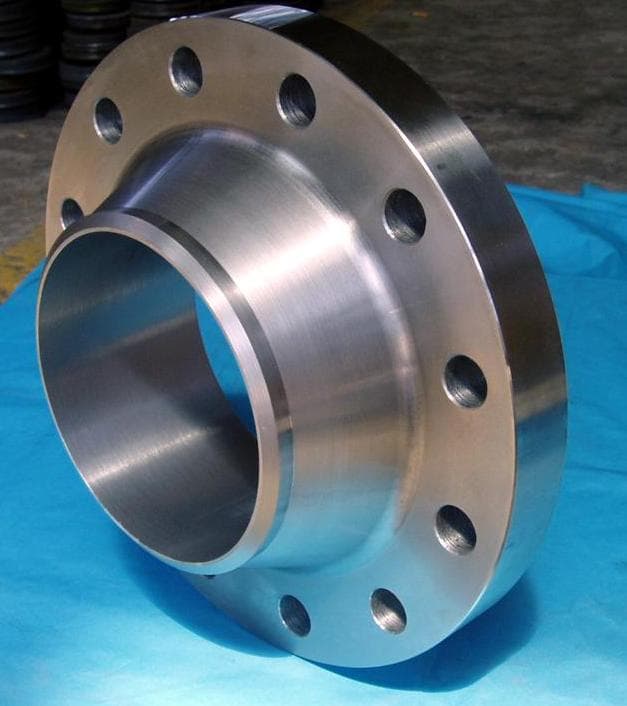
ASTM A105 is the workhorse specification for forged carbon steel flanges, fittings and valves used in ambient and elevated-temperature pressure piping. Most procurement disputes around A105 forged flange orders trace back to three areas: chemistry, hardness and heat treatment. Getting these right at the PO stage avoids re-inspection, NCRs and costly site rejections.
This guide summarises what the standard actually requires, what the common interpretation pitfalls are, and what to write into your inquiry to your forging supplier.
Key technical facts
The ASTM A105 / ASME SA-105 specification sets the following ladle (heat) chemistry limits for the base composition:
| Element | Limit (wt %) |
|---|---|
| Carbon (C) | 0.35 max |
| Manganese (Mn) | 0.60 - 1.05 |
| Phosphorus (P) | 0.035 max |
| Sulfur (S) | 0.040 max |
| Silicon (Si) | 0.10 - 0.35 |
A105 also allows a controlled trade between carbon and manganese: for each 0.01% reduction in carbon below 0.35%, an additional 0.06% manganese above 1.05% is permitted, up to a Mn ceiling of 1.65%. This is the basis for many modern "low-carbon, high-Mn" A105 heats that improve weldability while staying inside the standard.
Hardness on the finished forging shall be 137 to 187 HB (Brinell). This is a relatively narrow window; soft heats below 137 HB are just as much a non-conformance as hard heats above 187 HB.
Decision matrix: chemistry and heat treatment
| Buyer concern | What to specify in the PO |
|---|---|
| Welding to high-CE pipe | Cap CEV (IIW formula) at 0.43 max in addition to A105 |
| Sour service downstream | Add NACE MR0175 / ISO 15156 compliance and 22 HRC max |
| Low-temperature exposure | Switch to ASTM A350 LF2; A105 has no impact requirement |
| Sizes above NPS 4 | Require normalizing (per Supplementary Requirement S7 or PO note) |
| Repair welds | Require disclosure and PWHT records |
A105 itself does not mandate a specific heat treatment for flanges below the standard's threshold sizes, but normalizing, annealing, or quench-and-temper are all permitted to reach the chemistry / hardness / mechanical envelope. For larger forged flanges and non-standard forgings, normalizing is the most common choice as it refines grain and stabilises mechanical properties.
Common procurement mistakes
- Assuming A105 has impact toughness. It does not, by default. If your design temperature is below 0 degC, specify A350 LF2 instead.
- Ignoring the Mn/C trade. Some buyers reject heats with Mn above 1.05% even though the standard explicitly permits up to 1.65% with a corresponding C reduction.
- Confusing supplier hardness reports with batch hardness. A105 hardness is a per-forging requirement, not a per-heat one. Insist on traceable hardness on every forging.
- Forgetting the 4 inch / NPS 4 PWHT trigger. Larger forgings made by hot working have a heat treatment requirement that must appear on the MTC.
- Mixing A105 and A105N in the same PO line. A105N is the same specification with a normalized heat treatment supplementary requirement; treat it as a distinct deliverable.
Buyer checklist
- Confirm chemistry on the EN 10204 3.1 or 3.2 MTC, including the Mn/C trade if invoked.
- Verify Brinell hardness 137-187 HB on each forging.
- For NPS 4 and above (or hot-worked forgings beyond standard thresholds), confirm normalizing and supplier documentation of soak temperature and time.
- Ask for the CEV calculation if you intend to weld to thick-wall pipe.
- Cross-reference our forged flanges and non-standard forgings catalogue and request a sample MTC before placing the full order.
- For combined orders with seamless butt-welding pipe fittings, align heat numbers where possible to simplify site documentation.
- Send your enquiry through our inquiry form with size, rating, face type and any supplementary NACE / impact requirements.
Sources
- https://www.octalsteel.com/pdf/astm-a105-flange-specification.pdf
- https://www.valvespecifications.com/material/astm-a105-chemical-composition-mechanical-properties
- http://www.metalspiping.com/astm-a105.html
Need a quote for the products mentioned in this article?
Submit your specs and our pressure piping team will respond within one business day.
Send RFQRelated reading
 Technical
Grain Size Verification for Forged Stainless Fittings
Grain size testing under ASTM A182 is mandatory only for certain grades. Learn when ASTM E112 applies, which methods are used, and what buyers must verify before accepting a fitting.
Technical